Note
Go to the end to download the full example code.
QAOA
Here we generate and optimize pattern for QAOA circuit.
from __future__ import annotations

import networkx as nx
import numpy as np

from graphix import Circuit

rng = np.random.default_rng()

n = 4
xi: np.ndarray[tuple[int], np.dtype[np.float64]] = rng.random(6)
theta: np.ndarray[tuple[int], np.dtype[np.float64]] = rng.random(4)
g: nx.Graph[int] = nx.complete_graph(n)
circuit = Circuit(n)
for i, (u, v) in enumerate(g.edges):
    circuit.cnot(u, v)
    circuit.rz(v, xi[i])
    circuit.cnot(u, v)
for v in g.nodes:
    circuit.rx(v, theta[v])
transpile and get the graph state
pattern = circuit.transpile().pattern
pattern.standardize()
pattern.shift_signals()
pattern.draw_graph(flow_from_pattern=False)

Pauli flow detected in the graph (causal flow not detected)
perform Pauli measurements and plot the new (minimal) graph to perform the same quantum computation
pattern.remove_input_nodes()
pattern.perform_pauli_measurements()
pattern.draw_graph(flow_from_pattern=False)
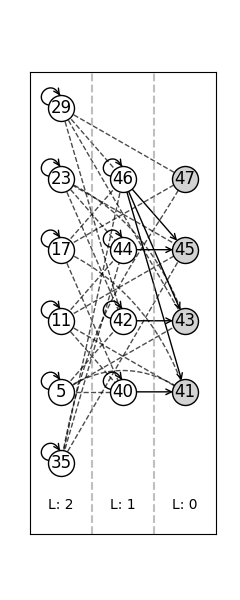
Pauli flow detected in the graph (causal flow not detected)
finally, simulate the QAOA circuit
out_state = pattern.simulate_pattern()
state = circuit.simulate_statevector().statevec
print("overlap of states: ", np.abs(np.dot(state.psi.flatten().conjugate(), out_state.psi.flatten())))
# sphinx_gallery_thumbnail_number = 2
/home/docs/checkouts/readthedocs.org/user_builds/graphix/checkouts/v0.3.5/examples/qaoa.py:50: UserWarning: Default random-number generator is used. Results may not be reproducible.
  out_state = pattern.simulate_pattern()
overlap of states:  0.9999999999999996
Total running time of the script: (0 minutes 1.114 seconds)