Note
Click here to download the full example code
Optimized pattern fragments
Graphix offers several pattern fragments for quantum gates, pre-optimized by reducing the Pauli measurements, with fewer resource requirement than the standard pattern.
First, for Toffoli gate, here is the pattern based on the decomposition of CCX gate with CNOT and single-qubit rotations, turned into a measurement pattern:
import numpy as np

from graphix import Circuit

circuit = Circuit(3)
circuit.ccx(0, 1, 2)
pattern = circuit.transpile().pattern
pattern.draw_graph(flow_from_pattern=False)
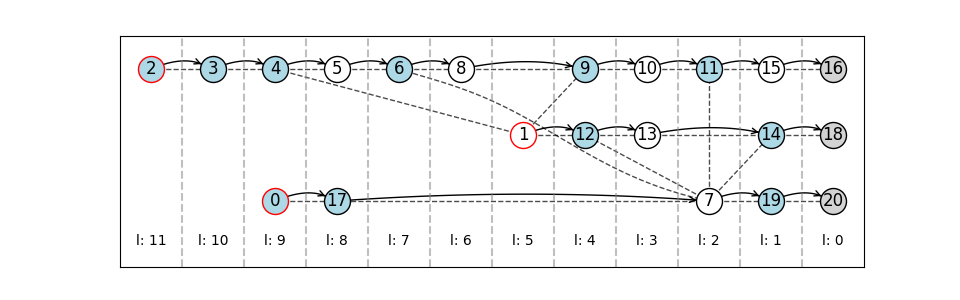
Flow detected in the graph.
Using opt=True option for transpile method, we switch to patterns with non-XY plane measurements allowed,
which has gflow (not flow). For CCX gate, the number of ancilla qubits required is nearly halved:
pattern = circuit.transpile(opt=True).pattern
pattern.draw_graph(node_distance=(1.2, 0.8))
# sphinx_gallery_thumbnail_number = 2
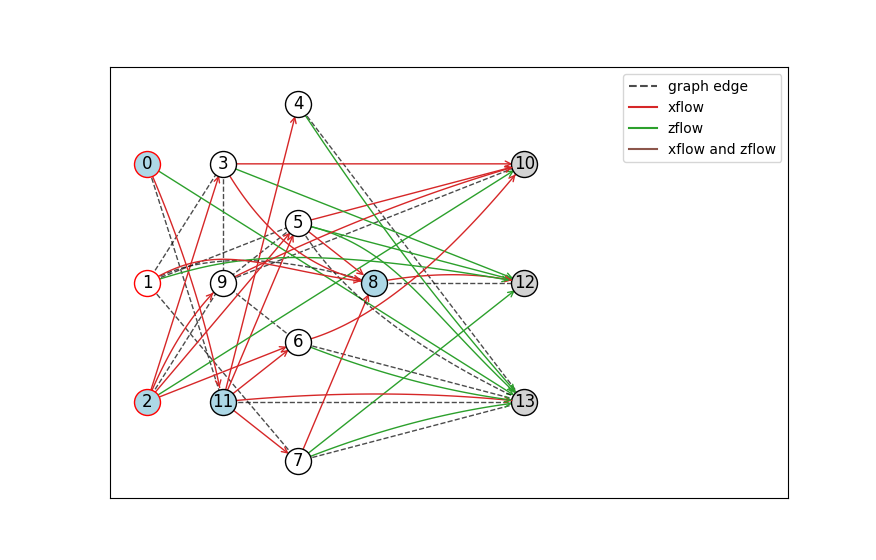
The pattern is not consistent with flow or gflow structure.
Now let us add z-rotation gates, requiring two ancillas in the original pattern fragment,
which becomes one for patterns with opt=True.
circuit = Circuit(3)
circuit.ccx(0, 1, 2)
for i in range(3):
    circuit.rz(i, np.pi / 4)
pattern = circuit.transpile(opt=True).pattern
pattern.draw_graph(flow_from_pattern=True, node_distance=(1, 0.5))
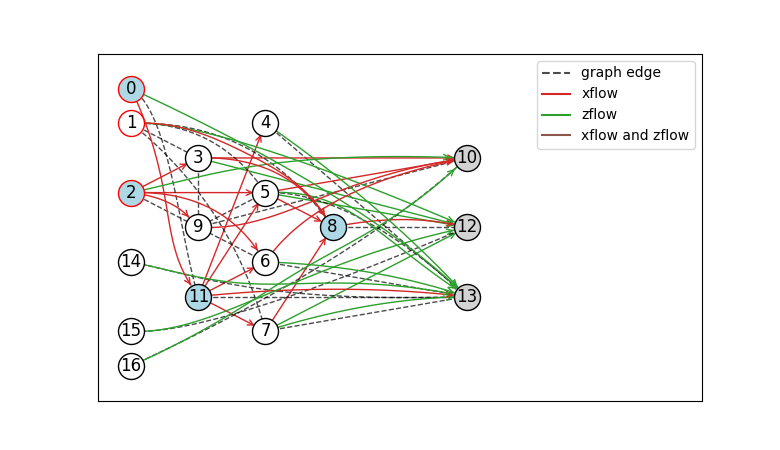
The pattern is not consistent with flow or gflow structure.
Swap gate is just a swap of node indices during compilation, requiring no ancillas.
circuit = Circuit(3)
circuit.ccx(0, 1, 2)
circuit.swap(1, 2)
circuit.swap(2, 0)
for i in range(3):
    circuit.rz(i, np.pi / 4)
pattern = circuit.transpile(opt=True).pattern
pattern.draw_graph(flow_from_pattern=False, node_distance=(1, 0.4))
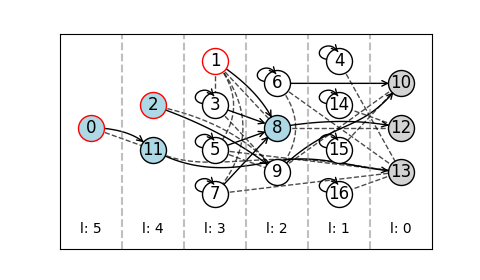
Gflow detected in the graph. (flow not detected)
using opt=True and with either CCX, Rzz or Rz gates, the graph will have gflow.
circuit = Circuit(4)
circuit.cnot(1, 2)
circuit.cnot(0, 3)
circuit.ccx(2, 1, 0)
circuit.rx(0, np.pi / 3)
circuit.cnot(0, 3)
circuit.rzz(0, 3, np.pi / 3)
circuit.rx(2, np.pi / 3)
circuit.ccx(3, 1, 2)
circuit.rx(0, np.pi / 3)
circuit.rx(3, np.pi / 3)
pattern = circuit.transpile(opt=True).pattern
pattern.draw_graph(flow_from_pattern=False, node_distance=(1, 0.4))
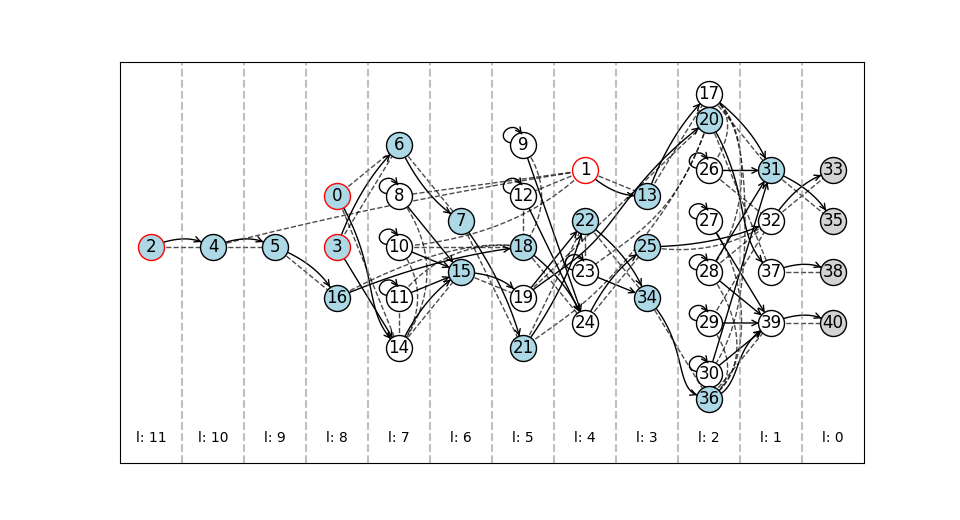
Gflow detected in the graph. (flow not detected)
reducing the size further
pattern.perform_pauli_measurements()
pattern.draw_graph(flow_from_pattern=False, node_distance=(1, 0.6))
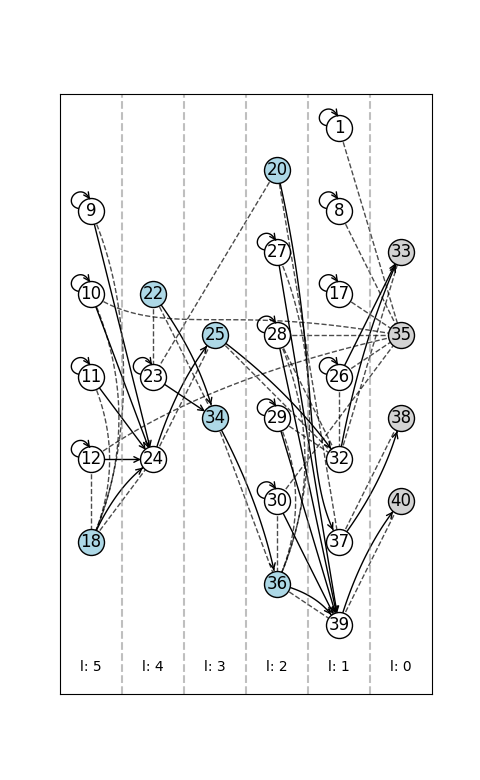
Gflow detected in the graph. (flow not detected)
For linear optical QPUs with single photons, such a resource state can be generated by fusing the follwoing microcluster states:
from graphix.extraction import get_fusion_network_from_graph

nodes, edges = pattern.get_graph()
from graphix import GraphState

gs = GraphState(nodes=nodes, edges=edges)
get_fusion_network_from_graph(gs, max_ghz=4, max_lin=4)
[GHZ[35, 30, 28, 26], GHZ[36, 39, 34, 30], GHZ[18, 24, 12, 11], GHZ[32, 33, 29, 28], GHZ[35, 1, 17], GHZ[35, 8, 12], LINEAR[9, 18, 10, 35], LINEAR[24, 25, 32, 26], GHZ[36, 27, 29], GHZ[28, 36], LINEAR[34, 22, 23, 20], GHZ[37, 38, 20], GHZ[39, 40]]
Total running time of the script: ( 0 minutes 2.967 seconds)